New Year 2026: The Beta Series and the Road to 1.0
When I announced the mooR 1.0-beta1 release in mid-November, we committed to a period of “bug fixes and stability” leading up to a final 1.0. That has been mostly true; we have avoided major feature creep, and the database format has remained stable throughout the beta series.
Explore the Project: GitHub | Support Development | Join our Discord | Connect to Timbran Hotel
However, we did end up undertaking significant optimisation work that touched nearly every corner of the codebase. We also found ourselves doing more feature work than planned in two specific areas: the web client and agentic AI tooling. This was driven in large part by a push to transform what was a demonstration / development MOO, the “Timbran Hotel”, into a more functional public demonstrator and a space for testing new modes of interaction.
As we start 2026 with today’s release of Beta 7 (which I feel is really probably damn close to an actual final release candidate, but I’m afraid to call it that), it is worth looking back at the two-month sprint that brought us to this point.
The Beta Cycle: November - December 2025
The focus of the Beta cycle has been preparing mooR for production use. Beyond standard maintenance, this involved significant work on the system’s core performance and how it presents itself to the modern web.
Performance Optimisation
In early December (Beta 4), we landed a significant architectural overhaul of the system’s internal value representation. By restructuring how the interpreter handles data in memory, we substantially reduced the overhead involved in managing and copying values.
While traditional single-threaded servers like LambdaMOO and ToastStunt can still hold an edge in some specific verb-dispatch-heavy workloads, mooR’s raw bytecode execution speed is now highly competitive. More importantly, its multi-threaded architecture allows it to easily outperform those engines once even a few concurrent tasks are running on modern multi-core hardware.
On a modern machine, mooR is a performant (and stable) way to host a virtual community or game.
”AI” Integration and Agentic Tools
So 2025 was (apparently) the year of “Agentic AI.” You probably noticed. But it was also the year I realised that beyond the current hype cycle, and my own cynicism, these tools do in fact have specific, practical applications. For MOOs and MUDs especially… beyond the fact that I simply couldn’t have gotten half the things I did done without agentic coding tools, I think that because these environments are inherently narrative and language-focused—built entirely on “words in, words out”—LLMs are uniquely suited for them in a way they might not be for other domains where they are currently being pushed.
So I began the year skeptical, and I remain cautious and critical of generative AI in many contexts. However, as a free software developer, I believe I have found a niche for these tools that is genuinely compelling. Some of this work came out of our push to make “Timbran Hotel” more than just a development environment, but a functional public demonstrator for new ways of interacting with collaborative spaces.
We have already integrated “in-world” AI agents into the Cowbell core—such as the “Data Visor” and “Architect’s Compass”—which are examples that use open-weight AI models to help builders and programmers construct rooms and create interactive objects in-world. Regular users on “Timbran Hotel” can already make use of these agents and others in a transparent way. For example, they can check into their own personal hotel rooms by talking to the front-desk clerk, ask for directions between locations, or just ask the concierge for gossip about events it has witnessed in the world. If they make a mistake typing a command, the system will try to help.
But on top of that, the new mooR MCP server takes this further by allowing people to use external agentic tools like Claude Code, Gemini CLI, and OpenCode to interface directly with the MOO. It connects over mooR’s RPC layer directly to the system and then lets agents automate all sorts of tasks, providing full access to programmer and administrator tools: building new objects and rooms, debugging and editing MOO verb code, or writing entire new areas in the world, updating descriptions—basically anything your character could do. It’s actually fascinating to watch the coding tools work in this environment.
Notably, the system uses a shared capability model: the same high-level “tools” written in MOO code are available to both our internal agents and external MCP-connected assistants. This means any extension to the world’s toolset immediately benefits both in-world AI and external development tools.
Continued work on the web client…
For … a really long time… MUDs and MOOs have been a niche, primarily retro geeky pursuit, often requiring custom clients and a tolerance for retro-text interfaces.
While that heritage is important, our goal with the mooR web client is to make this medium relevant for a broader audience.
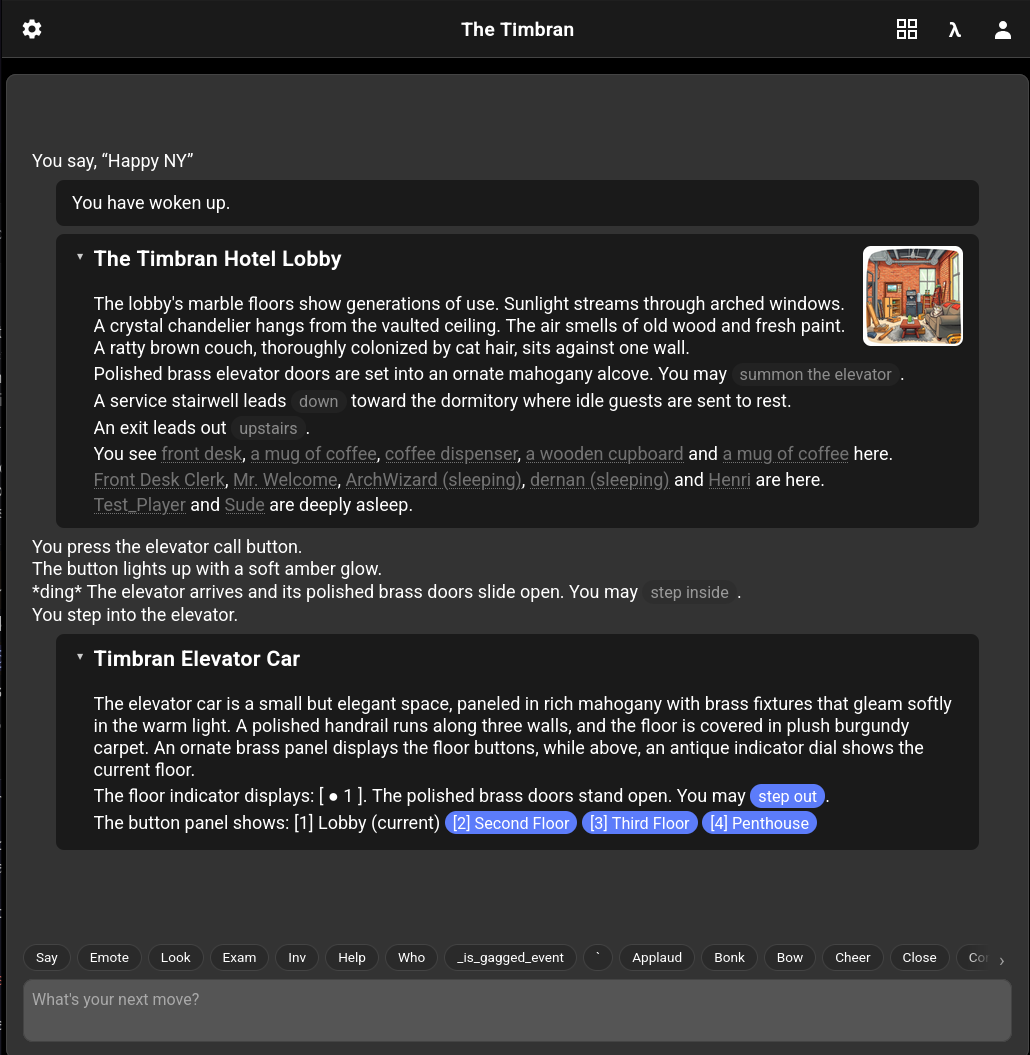
This means providing an environment where someone can drop in from their phone or desktop and find it immediately obvious how to navigate and interact. To that end, we have introduced:
- Modern Onboarding: Support for Discord OAuth2 login (among other authentication methods) and a player creation wizard for setting up profiles, pronouns, and avatars.
- Discoverability: Rooms now feature formatted text and tappable links for objects, commands, and exits. The client also presents a “palette” of available command verbs based on the current environment, supported by full tab-completion to help guide users through the world’s possibilities.
- Persistent History: Full infinite scrollback and persistent event history, ensuring the world feels like a continuous space rather than a transient terminal session.
- Rich Interaction: Rewritable prompt events for asynchronous workflows and integrated media support, allowing for structured data like thumbnail images alongside traditional text.
We want to lower the barrier to entry without sacrificing the depth and programmable power that makes the MOO platform unique.
Building with Cowbell
Parallel to the server work, we spent the last two months battle-testing the engine by building Cowbell, our new standard core. In November, my workflow was largely traditional: building features locally on my system on top of the bare core and then bringing them into the “Timbran Hotel” demonstrator MOO. This manual process was inherently unstable, often leading to synchronization issues and broken environments as I tried to bridge the gap between local development and the live server.
Starting in mid-December, this flow reversed. Development shifted almost entirely to being “in-MOO,” using a combination of the web client’s authoring tools and our new agentic AI tools (both in-world and via MCP). Moving to a fully live, internal development cycle provided the stability we needed and became the primary driver for our most important fixes and features.
A significant portion of Cowbell’s recent evolution came directly out of this push, including:
- Web Native Integration: Deepening the interaction with the web client for inline links, verb palettes, and environment-aware suggestions.
- Declarative Logic: Refining the rules engine—a Datalog-style logic system that allows builders to configure locks, puzzles, and access controls using declarative logical expressions rather than writing imperative MOO code.
- Perspective-Aware Events: A sophisticated event system that handles grammar and conjugation automatically based on who is viewing the action.
- Accessibility & Polish: A steady stream of bug fixes, formatting improvements, and accessibility refinements discovered through active use in the “Timbran Hotel”.
The goal has been to make Cowbell less of just a library of objects or ideas, and more of a demonstration of how mooR’s modern features can be used to build a coherent, accessible, and programmable world from the inside out.
Migration and Compatibility
With the release of Beta 7, we are continuing to refine our story for migrating existing MOO communities. While we have long supported importing any LambdaMOO 1.8.x compatible database, we lacked a clear path for communities running on more recent server forks.
During this cycle, we have made significant steps to improve ToastStunt compatibility. We are now able to import the full ToastCore database, and we are actively looking for users to help us test this migration flow and identify remaining edge cases. If you are interested in helping, please join us on Discord. Our goal is to make it as straightforward as possible for established communities to bring their worlds into a modern, multi-threaded environment.
With the database format settled and the interpreter performance where we want it, we are at the point where we need more people actually using the system to help us find the next round of bugs.
Looking Ahead to 1.0
We enter 2026 with the project largely in a feature-freeze and I’m still trying like crazy to get to an impactful 1.0. By which I mean: beyond stability I want something I can “show off” in a big splash that attracts users.
So the road from here to a final 1.0 release is about two things: firstly the “boring” but necessary work of finishing the documentation, squashing the remaining bugs, and continuing with performance tuning. Secondly, some more taxing work making the “Timbran Hotel” or other MOOs as things to show off so that this rather “heretofore obscure” type of software could be something far more mainstream, something that people’s mothers, friends, coworkers, etc. could try and become interested in.
That said: the pace of development has been extremely intense since I left full-time (non-mooR) paid work at the end of August. But that chapter is now coming to a close, as necessity requires me to shift gears to taking a full-time paid job. As a result, the breakneck speed of the last few months will naturally slow, but mooR has evolved into a stable platform for the kinds of experiments in collaborative computing and narrative spaces that originally drew me to this medium.
So in this context, it becomes even more important to emphasize we are still looking for donations (or even investment, contact me!) to support the ongoing costs of the project, and we are looking for able-bodied hands to assist with the work ahead.
I started 2025 skeptical of the new directions the industry was taking, but through this project, I feel I’ve found a way to make these old ideas work for a modern context in a way that is personally fulfilling.
If you haven’t checked in since the initial beta announcement, I’d encourage you to connect to “Timbran Hotel” and join the conversation on our Discord server.
Acknowledgments and Contributions
While I have been the primary driver of this work, the progress in this beta cycle wouldn’t have been possible without the contributions of others.
In particular, I want to thank Norman Nunley Jr. for his significant contributions during the Beta 6 and Beta 7 releases. Norman undertook a deep dive into the compiler’s internals, identifying several lingering bugs and implementing a much more robust testing and verification suite. His work has fundamentally improved the stability of the language runtime. Beyond that, he is already hard at work on several significant features that we expect to see in the post-1.0 development cycle.
I also want to thank: Blake Oliver, who provided a wealth of valuable feedback throughout the cycle and contributed the implementation for exposing builtin function documentation directly via the new function_help() builtin. This kind of work is essential for making the system truly discoverable for developers. Jules Iaccarino who has continued to thoroughly test the system and help us uncover edge cases that otherwise would have gone unnoticed. As always, Stephen Owens has been a constant help, contributing documentation and book feedback while providing the kind of “big thinking” advice that helps keep the project’s long-term goals in perspective. “Rune” gave extensive feedback as part of his ongoing work to port his MOO over to mooR. And I’m sure I’ve missed other people who dropped into the Discord to help out or engage in conversation.
Finally, thank you to the random people who have dropped by the MOO to test things out, poke at the walls, and give us a reason to keep building.
mooR is open source at github.com/timbran-project/moor. Cowbell is maintained in the same repository.